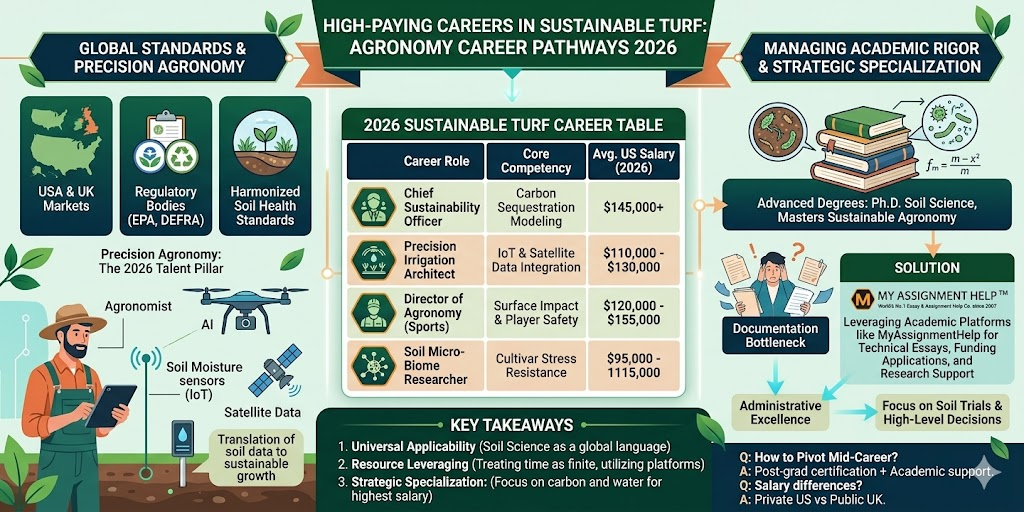
The “Green Industry” in 2026 is no longer defined by aesthetic maintenance but by environmental stewardship and biological engineering. For professionals in the USA and the UK, this transition represents a shift from traditional landscaping to high-stakes agronomic consulting. As municipal and private sectors demand “Zero-Water” and “Carbon-Neutral” landscapes, the demand for certified experts has created a lucrative new tier of executive-level turf roles.
Global Standards: Bridging the US and UK Markets
While the regulatory bodies differ—the EPA in the United States and DEFRA in the UK—the scientific benchmarks for soil health and nitrogen runoff are becoming increasingly harmonized. This “Universal Agronomy Standard” allows professionals to pivot between global markets. Whether managing a premier links course in Scotland or a municipal park system in California, the core competency remains the same: the ability to translate complex soil data into sustainable growth.
The 2026 Talent Pillar: High-Paying Careers in Sustainable Turf
The highest information gain in the industry currently lies in Precision Agronomy. Those who can integrate AI-driven moisture sensors with traditional horticultural knowledge are commanding premium salaries.
| Career Pathway (Global Reach) | Core Competency | Avg. US Salary (2026) |
| Chief Sustainability Officer (Turf) | Carbon Sequestration Modeling | $145,000+ |
| Precision Irrigation Architect | IoT & Satellite Data Integration | $110,000 – $130,000 |
| Director of Agronomy (Sports) | Surface Impact & Player Safety | $120,000 – $155,000 |
| Soil Micro-Biome Researcher | Cultivar Stress Resistance | $95,000 – $115,000 |
Managing the Academic Rigor of Advanced Agronomy
Advancing into these high-paying roles requires more than field experience; it demands academic authority. A Ph.D. in Soil Science or a Master’s in Sustainable Agronomy involves grueling research into chemical leaching, microbial diversity, and environmental law.
In the competitive educational landscape of the USA, professionals often find that the bottleneck to their career pivot isn’t the fieldwork, but the massive documentation requirements. Utilizing academic resource platforms to manage the rigorous research requirements of a Ph.D. in Soil Science is becoming a standard strategy for executive-level candidates. For instance, securing a custom scholarship essay writing service can help a candidate focus on their primary soil trials while ensuring their funding applications are technically flawless. By leveraging the specialized expertise of MyAssignmentHelp, aspiring agronomists can ensure a 10-word gap between their field-based research and the administrative excellence required for global certifications.
The “Information Gain” Strategy for Career Growth
To secure a top-tier role in 2026, candidates must demonstrate “Information Gain”—the ability to provide insights that go beyond standard textbooks.
- The Soil-Carbon Connection: Expertise in how specific turf varieties act as carbon sinks is currently the #1 skill sought by US municipal planners.
- Bio-Retention Design: Understanding how turfgrass facilitates urban cooling is a major career driver in high-density UK cities.
- Resource Management: Rather than just “doing the work,” the elite agronomist manages a suite of tools. This includes everything from soil sensors to utilizing professional platforms to pay for essay and technical report support, allowing the expert to focus on high-level decision-making.
See also: How to Improve Business Efficiency
Key Takeaways
- Universal Applicability: Soil science is a global language; mastering it allows for a career that spans from the USA to Europe.
- Resource Leveraging: Top-tier professionals treat their time as a finite resource, utilizing academic platforms to manage the burden of heavy research documentation.
- Strategic Specialization: Focus on carbon sequestration and water conservation to hit the highest salary brackets.
Frequently Asked Questions (FAQ)
Q: How does the “Career Pivot” to Agronomy work for mid-career professionals?
A: Most transition by gaining a post-graduate certification in Soil Science, often using academic support platforms to balance their current workload with new research requirements.
Q: Is there a significant salary difference between the US and UK?
A: While the US often has higher base salaries in the private sector, the UK offers significant opportunities in public infrastructure and heritage site management.
Author Bio
Jordan Hayes is a Senior Content Specialist at MyAssignmentHelp, where he develops editorial strategies for the 2026 SEO landscape. With a background in career pathing and academic research, Jordan focuses on helping professionals in the USA and beyond achieve E-E-A-T authority in technical fields.